Electric Wheelchair Parts: OEM vs Aftermarket Comparison 2026
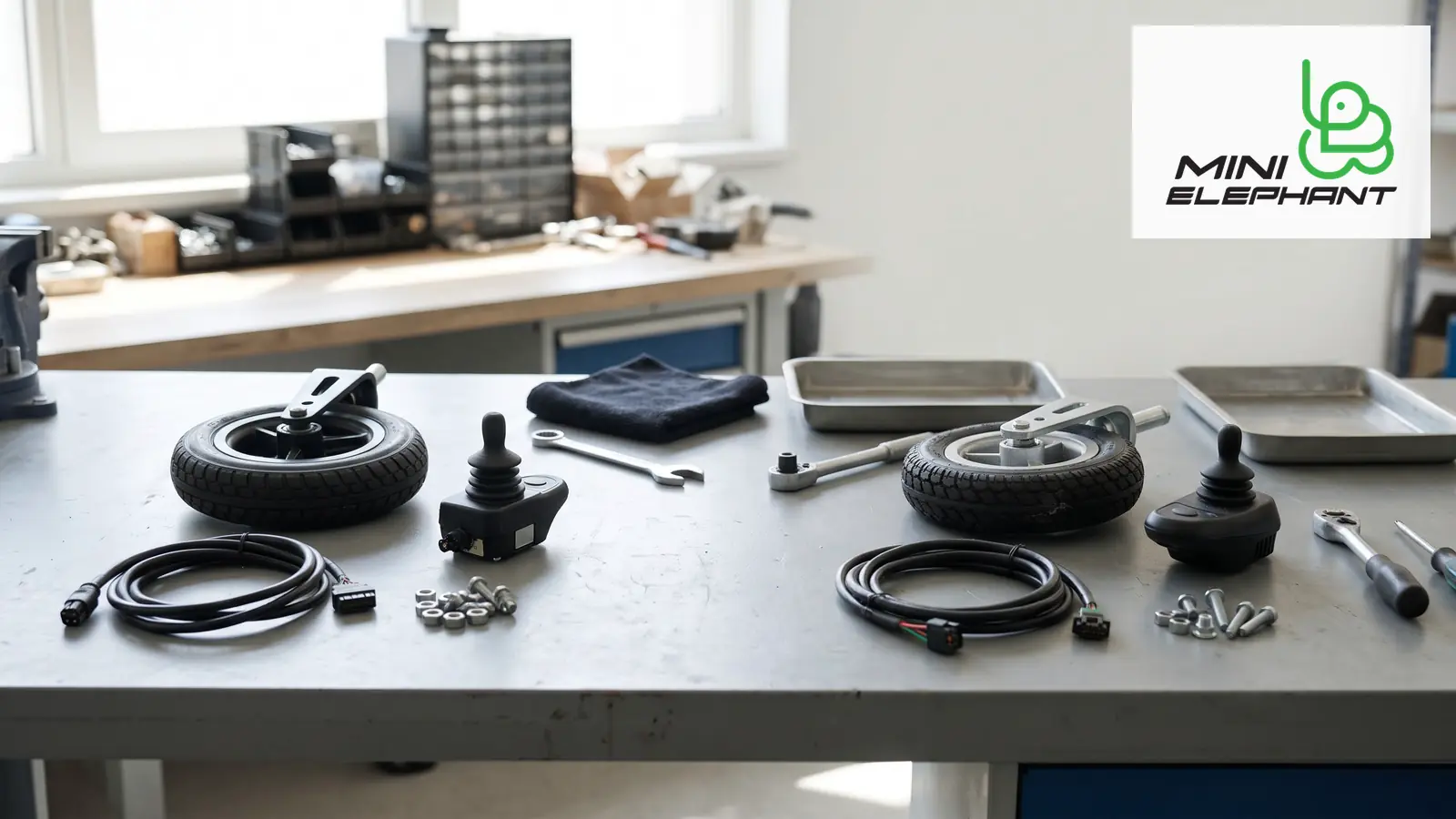
For an electric wheelchair dealer or importer, neither original factory parts nor third-party replacements win on every line. Original components keep the approved configuration, the part-number trail and the supplier relationship intact. Aftermarket parts can shorten a repair wait and reduce the cost of an electric wheelchair wear item, but they move the burden of proving compatibility onto you. The defensible approach is a written part-identification standard, a short list of components you never substitute, and every other electric wheelchair part decided item by item against evidence.
An electric wheelchair is assembled from a frame, a drive system, a controller, a battery system, wheels and casters, seating components and a large number of small fasteners and brackets. Those parts do not wear at the same rate, they are not equally critical, and they are not equally easy to substitute. That is why the practical question for a dealer is not "original or aftermarket" in general, but "which class of electric wheelchair part am I replacing, and what evidence do I hold for this specific unit".
This review compares the two sourcing routes objectively from the buyer side, then turns the comparison into a decision framework a service manager or purchasing team can apply this week. It is commercial purchasing guidance, not legal, regulatory or warranty advice. Market-entry obligations and contract rights depend on the destination market and on the written terms you actually signed, so confirm them with your own advisers.
Background: why electric wheelchair parts sourcing became a commercial decision
For most of the last decade, distributors bought electric wheelchair spare parts as an afterthought attached to a container order. The assumption was that the factory would always be the cheapest and safest source, and that assumption generally held while order cycles were long and freight was predictable.
Three things changed. Freight and lead-time variability made a single missing caster assembly expensive in downtime rather than in parts cost. Local mobility dealers began competing on repair turnaround, not only on the sale. And the range of third-party electric wheelchair components widened sharply, from generic fasteners and upholstery to joystick modules, chargers and complete wheel assemblies offered through marketplaces with very little documentation.
The result is a genuine choice with real trade-offs. A dealer who refuses every non-original electric wheelchair part carries more capital in slow-moving inventory and longer repair waits. A dealer who treats every part as interchangeable carries a compatibility and liability risk that surfaces months later, usually on the electric wheelchair belonging to the most vocal customer.
The comparison that matters is not brand loyalty versus price. It is documented identity versus undocumented assumption.
What actually counts as an original electric wheelchair part
An original part is a component supplied by, or approved in writing by, the original manufacturer for a defined electric wheelchair model and revision, and identifiable by a part number that traces back to the build record. The identification is the substance. Without a part number and a model reference, "original" is a claim rather than a fact.
There is an important nuance that buyers often miss. Many components inside an electric wheelchair are themselves made by specialist suppliers: motors, gearboxes, joystick controllers, chargers, batteries, tires and casters. A part being "original" means it was the approved component for that build, not that the chair brand manufactured it in its own plant. This matters twice. First, the same specialist component may legitimately exist in an aftermarket channel under the component maker's own identity. Second, an approved component can change between production revisions, so the revision matters as much as the part number.
What actually counts as an aftermarket electric wheelchair part
An aftermarket part is produced by a party other than the original manufacturer to fit the same application. Quality spans an extremely wide range: components manufactured to a published drawing and tested to the same interface, components reverse-engineered from a sample, and components that merely look similar in a photograph.
The commercial attraction is straightforward. Aftermarket electric wheelchair parts are often available locally, in smaller quantities, with shorter waits, and at a lower unit cost than a factory shipment. The commercial risk is equally straightforward: none of those advantages create proof of compatibility. That proof is the buyer's job, and it is the single line item most often left out of the purchase decision.
Five criteria for comparing electric wheelchair part sources
1. Identity and traceability. Can you point to a part number, a drawing or a specification for the exact component, and connect it to the model and revision of the electric wheelchair it will be fitted to? If the answer is a photograph and a message, you have a sample, not a specification.
2. Configuration control. Will you be told when the original design changes? A wheel diameter that stays the same while the hub width, axle bore or brake clearance changes will fit one production batch and not the next. Ask how revision changes are communicated for each electric wheelchair model you stock.
3. Electrical compatibility. Chargers, battery packs, controllers, joysticks and motors interact. Connector shape is the weakest possible proof of compatibility. Voltage, current limits, charge profile, protection logic and wiring pinout all have to match the approved configuration, and that has to be confirmed in writing.
4. Warranty and claim record. A part substitution changes the evidence trail for a future claim. What the supply agreement says about non-approved components is what governs, and that wording differs between suppliers. Read it before the first substitution, not after the first failure.
5. Availability, downtime and total cost. Compare landed part cost plus the cost of the unit being out of service plus the administrative cost of the claim path. A cheaper electric wheelchair part that arrives three weeks later is usually the more expensive decision.
Electric wheelchair parts comparison: original versus aftermarket
The table below compares the two routes on the decision areas above. It describes sourcing mechanics, not the offer of any specific supplier.
Identity and the look-alike caster problem
Casters and drive wheels are where visual substitution fails most often on an electric wheelchair. Two caster assemblies can share a nominal diameter and still differ in hub width, bearing type, axle bore, fork offset and the clearance needed by an anti-tip accessory. Fitted to a different revision of the same electric wheelchair, a "matching" caster can produce uneven rolling, accelerated bearing wear or interference with the footrest or frame.
The control is cheap and boring. Photograph the removed part next to a ruler, record the model, revision and serial number of the electric wheelchair, note the measured dimensions, and keep that record with the repair. A dealer with six months of such records can approve or reject a substitute in minutes instead of ordering a sample and waiting.
Electrical parts: where aftermarket substitution gets expensive
Chargers, battery packs, controller and joystick combinations, and motor assemblies carry the highest consequence per wrong decision on an electric wheelchair. A charger that physically plugs in can still be wrong for the battery system, because charge profile, cut-off behaviour and current limits are part of the design. A joystick module with the correct connector can still be wrong for the controller it talks to.
There is no shortcut here that survives an audit. Request the electrical specification, compare it line by line against the approved configuration for that electric wheelchair model, and obtain written confirmation before fitting. If a supplier cannot state the specification, that is the answer to the question. This is also the area where "it works in the workshop" is weakest evidence, because thermal and charging faults appear after weeks of use rather than in the first ten minutes.
Warranty records and the substitution trail
Substitution does not automatically invalidate anything, and no article can tell you what your contract says. What can be said with confidence is that a claim is decided on records. The dealer who can produce the part number fitted, the reason for the substitution, the supplier invoice and the service date is in a far stronger position than the dealer who can only describe the repair from memory.
Keep the trail deliberately. For every non-original electric wheelchair component, log the model and serial of the unit, the part reference, the equivalence evidence you accepted, the installing technician and the date. If a claim later arises, that record converts an argument into a documented sequence of decisions.
Downtime arithmetic: when an aftermarket part is commercially rational
The following figures are hypothetical and exist only to show how the comparison arithmetic works. They are not market rates, supplier prices or MiniElephant terms.
Assume a dealer whose service labour and loan-equipment cost together come to about 40 currency units per day that a customer electric wheelchair sits idle, and a factory part that lands 18 days after ordering against a local substitute available in 2 days. The 16-day difference represents roughly 640 currency units of downtime. If the substitute costs 60 units less than the factory part, the substitute still wins on this arithmetic by a wide margin, provided the equivalence evidence is adequate. If the substitute fails after six weeks and the unit returns, the same decision loses money once the second repair and the credibility cost are counted.
That is the whole framework in one paragraph: the shorter lead time is worth real money, and it is only worth it when the compatibility evidence is strong enough that a repeat repair is unlikely.
A practical decision framework for electric wheelchair parts
Sort every part into one of four buckets before you negotiate, and write the bucket into your service procedure so the decision is not re-argued at the bench.
Never substitute without written manufacturer confirmation. Chargers, battery packs, controller and joystick combinations, motor and brake assemblies, and any component that carries a structural load path on the electric wheelchair. The interface is the product here, and a near-match is a different part.
Substitute only against measured equivalence. Tires, casters, tubes, armrest pads, footrest components and similar wear items, where dimensions, load rating and material can be compared against the original. Accept the substitute when the measurements match and the documentation is adequate; reject when either is missing.
Substitute freely within dimensional limits. Fasteners, cable ties, cosmetic covers, non-structural brackets and general hardware, where the risk is mechanical fit rather than system behaviour. Even here, check thread type, grade and corrosion treatment, because a soft fastener on a vibrating electric wheelchair is a future failure.
Dealer preference. Upholstery, colour-matched trim and comfort accessories, where the customer's expectation governs and no system interface is involved.
Pre-approval checklist for any non-original electric wheelchair part
Before the fitting is approved, confirm all of the following and file the record:
- Model, revision and serial number of the electric wheelchair concerned
- Part number or measured dimensions of the original component being replaced
- Written specification of the substitute, compared line by line with the original
- Electrical rating and connector pinout where the part is powered
- Load or weight rating where the part carries load
- Photographs of the substitute fitted, not only loose on a bench
- Supplier invoice and stated traceability for the batch
- Note in the customer record that a non-original component was fitted, with the reason
What to put in the supply agreement instead of assuming
Ask the manufacturer to state, in writing, how part identification is provided, how revision changes are communicated, and what happens to a claim when a non-approved component has been fitted to an electric wheelchair. Ask the same questions of your aftermarket supplier about traceability and equivalence documentation. Neither answer has to be generous to be useful; it only has to be written down before a failure.
FAQ
Are aftermarket electric wheelchair parts illegal?
Not inherently. Legality is not determined by the sourcing route but by the rules of the destination market and by how the finished product is presented and supported. Replacing a component can affect the conformity of an electric wheelchair as placed on the market, so the importer and its local compliance advisers remain responsible for the market-entry position. Confirm the requirement for the specific model and market rather than relying on a general statement.
Will using an aftermarket part void my electric wheelchair warranty?
That depends entirely on the written terms, and it varies between suppliers. Some agreements cover only supplied components, others exclude damage caused by non-approved parts, and many say nothing specific at all. Read the clause before the first substitution, and record what you fitted either way. A documented, competent repair is a better position than an undocumented one regardless of the wording.
Can original and aftermarket parts be mixed on one electric wheelchair?
Usually yes for mechanical interfaces that can be measured, such as a caster or a fastener. The risky combination is electrical, where a substitute joystick, charger or controller interacts with the approved system on the electric wheelchair. Treat a mixed electrical repair on the electric wheelchair as a configuration change and obtain written confirmation before fitting.
How do I prove an aftermarket part is equivalent?
With a written specification and a measurement, not with a photograph. Compare dimensions, materials, load or electrical ratings, connector type and pinout against the original drawing or part record, then inspect the delivered sample against that comparison. Keep the comparison with the repair record for the electric wheelchair concerned.
Which electric wheelchair parts should always come from the original manufacturer?
As a conservative default: chargers, battery packs, controller and joystick pairs, motors and brake assemblies, and any structural component. These are the items where a near-match changes system behaviour rather than simply fitting slightly differently. The list is a starting point for your own service procedure, not a statement about any supplier's terms.
Where MiniElephant fits in this comparison
MiniElephant (Jiaxing Small Elephant Medical Technology Co., Ltd) builds the MiniRedone folding electric wheelchair range and supplies parts against the configuration that was actually ordered. For a dealer running the framework above, the useful request is specific: the part identification and compatibility note for the exact model and revision in your fleet, plus the written statement of how revision changes are communicated. That is the evidence an electric wheelchair service team needs to decide which parts stay original and which can be sourced locally.
For those documents, or to discuss a parts list alongside an electric wheelchair order, contact the export team at johnson@semwheelchair.com or WhatsApp +86 13819098967.
Related buying workflows: the electric wheelchair spare parts stocking guide, the warranty and after-sales guide, the pre-shipment inspection checklist and the dealer training guide.
Interested in MiniElephant Electric Wheelchairs?
Get a customized quotation and product recommendation from our export team. Response within 24 hours.