Electric Wheelchair Joystick and Controller Buying Guide
Electric Wheelchair Joystick and Controller Buying Guide
A joystick is not an interchangeable accessory; it is part of the complete control system. For B2B buyers, the right electric wheelchair controller must match the motors, battery system, wiring, software, mounting position, and intended operator. Comparing only the appearance of a joystick can create compatibility, safety, and service problems after delivery.
This guide is for importers, distributors, mobility retailers, and OEM buyers evaluating electric wheelchair configurations. Confirm all technical details with the manufacturer for the exact model and revision.
Compare the Complete Control System
Ask suppliers to identify the joystick module, controller, motor connections, battery interface, charger relationship, display or indicator, and any attendant-control or accessory ports. Record the part numbers and revision information in the quotation and product file.
The same joystick shape may be used with different electronic systems. A replacement must be approved for the exact chair; an apparently compatible connector does not prove that voltage, pinout, communication, programming, or protective functions match.
Review Layout and Operator Access
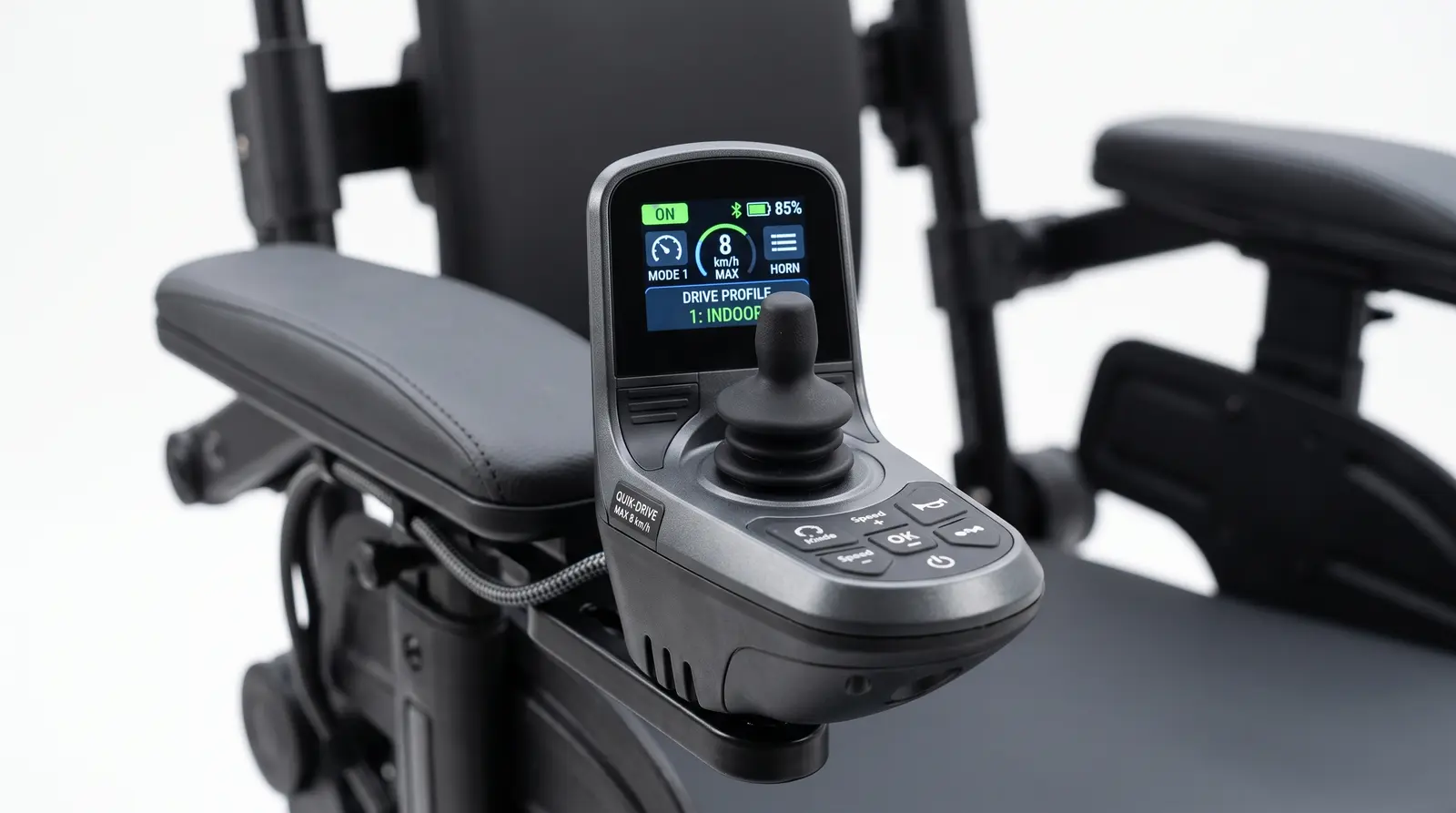
The control position should suit the intended user and the chair configuration. During a sample demonstration, review joystick reach, hand clearance, mounting rigidity, cable routing, display visibility, speed controls, horn, battery indicator, and access to charging information.
For a distributor range, distinguish standard and optional control layouts. Some customers may need a left-side mount, attendant control, alternative input, or a swing-away bracket. Do not promise suitability for a particular impairment without the appropriate professional assessment and model-specific confirmation.
Check Functional Behavior
A B2B evaluation should document basic control behavior under safe, controlled conditions. Check power-on interlock, forward and reverse movement, turning, speed adjustment, controlled stopping after joystick release, electromagnetic braking, fault indications, and freewheel behavior according to the manual.
Repeat the checks with the intended seating and accessory configuration. A different battery, motor, wheel, or controller setting can change system behavior. Record the model revision, sample identity, battery state, load, test surface, and any warnings observed.
Ask About Protection and Serviceability
The joystick is exposed to impact, spills, cables, transport, and repeated handling. Request information about the control's ingress protection, mounting strength, connector protection, cable bend radius, strain relief, and approved cleaning method. Inspect whether folding or loading can pull on the cable or strike the module.
For service planning, obtain the controller and joystick part numbers, compatible revisions, fault-code guide, programming requirements, replacement procedure, and expected lead time. Ask whether a technician needs a programming cable, software, training, or factory authorization. Keep approved spare units separated by model and revision.
Build a Distributor Comparison Table
| --- | --- |
Use this table alongside the approved sample and technical drawing. Record differences between standard and optional control packages so online listings and sales quotations remain accurate.
Plan Handover and After-Sales Support
Customers should receive a consistent demonstration of power-on, joystick direction, speed adjustment, braking, charging, fault indications, and safe freewheel use. They should know not to lift the chair by the joystick or pull the control cable. The manual for the delivered configuration should remain the primary operating reference.
When a problem is reported, collect the model, serial number where applicable, controller and joystick labels, battery and charger information, fault indication, photographs, operating conditions, and a short video when safe. Do not ask an untrained user to open the controller, bypass a safety device, or alter wiring.
B2B Selection Checklist
1. Identify the complete controller and joystick system by part number and revision.
2. Demonstrate reach, mounting, and control functions with the intended configuration.
3. Verify compatibility across motors, battery, charger, wiring, and software.
4. Inspect cable routing and transport protection before approving the sample.
5. Obtain fault, programming, spare-parts, and replacement information for local service.
6. Align manuals, labels, quotations, and online claims with the delivered configuration.
7. Use safe escalation procedures for electrical, braking, or control faults.
The B2B Bottom Line
A reliable electric wheelchair control system is selected as part of the complete chair, not by joystick appearance alone. Buyers who verify compatibility, operator access, functional behavior, protection, documentation, and service requirements can reduce avoidable returns and give distributors a clearer after-sales pathway.
**Evaluating electric wheelchair control systems for your market?** [Contact the MiniElephant export team](https://www.semwheelchair.com/contact) for model specifications, controller information, and B2B sourcing support.
Interested in MiniElephant Electric Wheelchairs?
Get a customized quotation and product recommendation from our export team. Response within 24 hours.