Electric Wheelchair Ramps and Slopes: Dealer Access Guide
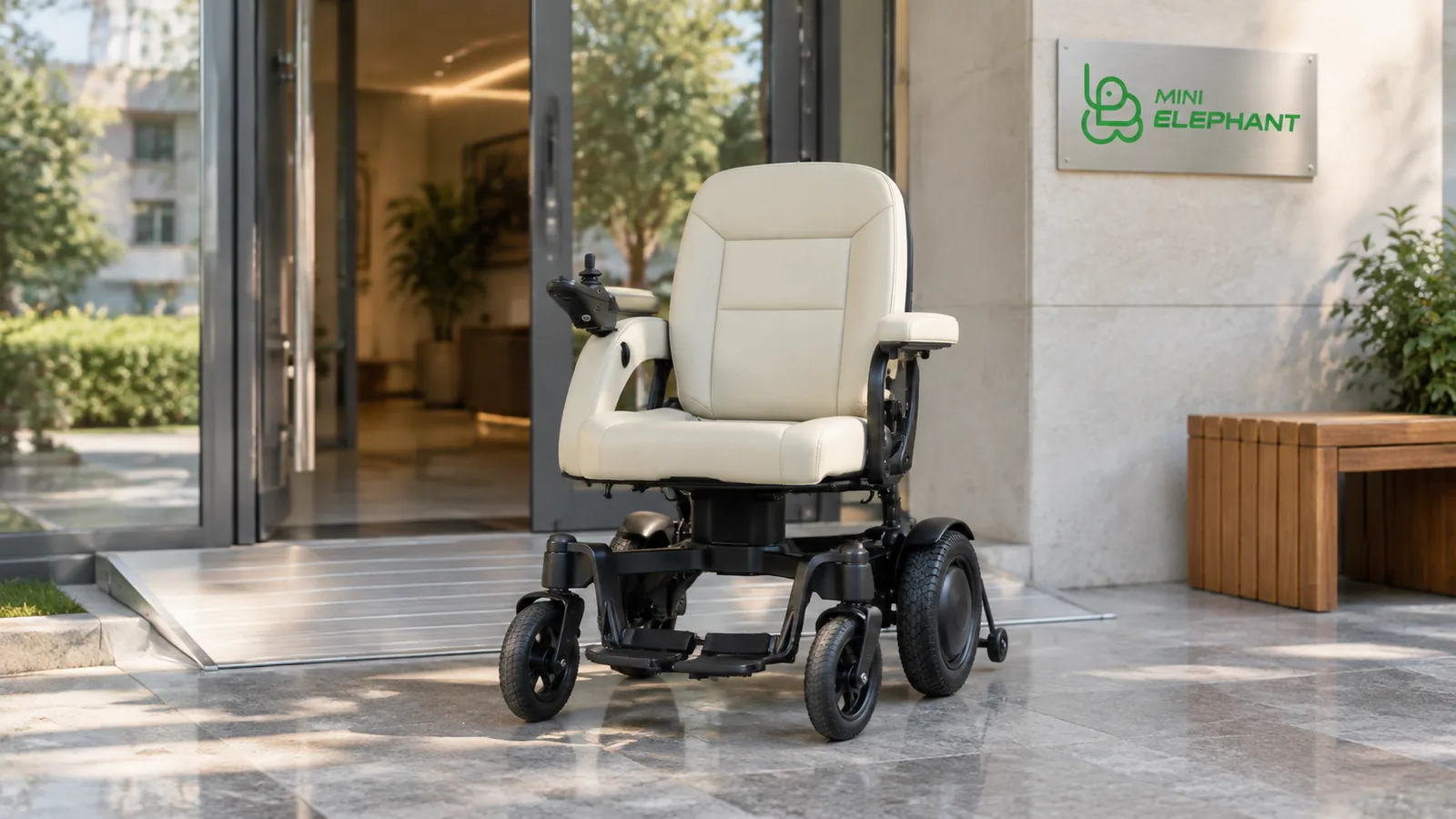
Before an electric wheelchair dealer quotes a ramp, measure five things: the rise in millimetres, the available run, the clear width of the narrowest point, the depth of the landing at the top, and the surface the chair will drive on. Get those five numbers and the rest of the conversation becomes engineering instead of opinion.
Ramp questions arrive early in almost every electric wheelchair deal, and they arrive badly. A buyer sends a photo of a front door and asks "will it go up this?" A hotel sends a corridor width and asks for a discount on six units. A clinic wants an electric wheelchair that "handles any slope." None of these can be answered from a photo, and none of them should be answered with a number invented on the spot.
This guide is the version of that conversation a dealer can run in fifteen minutes, with a tape measure and a phone calculator. It covers what to measure, how to convert a slope into something a buyer can check, what changes when the electric wheelchair itself weighs nearly fifty kilos, and where the honest limits are.
Why electric wheelchair ramp questions decide the sale
An electric wheelchair that climbs a showroom floor and fails at the customer's front door is not a product failure, it is a survey failure. The electric wheelchair did exactly what an electric wheelchair does. Nobody measured the threshold, nobody checked the landing depth, and nobody asked who would be pushing if the battery ran low on the last metre.
Dealers who close these sales cleanly treat access as part of the specification, in the same bracket as seat width and battery capacity. Ramp access is also the question buyers search for most often after they have already chosen an electric wheelchair model, which makes it a dealer problem rather than a product problem. They ask for the measurements before the quotation, they put the numbers in writing, and they keep the photographs on file. When a customer later says "it will not go up my ramp," the dealer already knows whether the ramp was 1:8 or 1:4, and the conversation stays commercial instead of becoming an argument about warranty.
Measure five things before you quote
A tape measure and fifteen minutes answer more electric wheelchair access questions than any brochure. Rise. The vertical distance from the lower surface to the upper surface, in millimetres. Measure at the steepest point of the route, not at the friendliest one. A driveway that rises 300 mm over four metres is a different problem from a single 90 mm door threshold, and both appear in the same customer's house.
Run. The horizontal distance available for the ramp itself, measured where the electric wheelchair will actually travel. This is where most residential projects fail: the rise is fine, the run does not exist. A 1:12 ramp for a 600 mm rise needs 7.2 metres of horizontal space before the landing. If the garden path is three metres long, the answer is not a steeper ramp, it is a different route or a different solution entirely.
Clear width. The narrowest point on the whole route, including door frames, gate posts, handrails that protrude, and the turn at the top. Accessibility guidance in many markets uses roughly 815 mm as a reference clear width for a straight approach, but the reference matters less than the actual chair: measure the unit the customer will receive, in its in-use configuration, and add hand clearance on both sides.
Landing depth. The flat area at the top of the ramp. An electric wheelchair that arrives at the top of a slope and immediately meets a door that opens toward it has nowhere to stand while the door is opened. A landing that allows the electric wheelchair to stop, straighten and wait is not a luxury detail, it is the difference between a usable entrance and a daily struggle.
Surface. Ask the customer to photograph it at the time of day the electric wheelchair will be used. Tiles, polished stone, loose gravel, wet concrete, painted steel, wooden decking and grass all behave differently under a 47 to 50 kg electric wheelchair with a seated occupant. Ask what the surface is, ask what happens to it in rain, and ask whether the route is covered.
Slope math every dealer should be able to do
Slope is rise divided by run. Most of the world quotes it as a ratio, some markets quote degrees, and buyers often quote a percentage without realising it is the same number in a different coat. Being able to move between the three is the single most useful skill in these conversations.
Two rules keep this table honest. First, the shorter the ramp, the less the ratio alone tells you: a 1:6 transition over 300 mm is a bump, a 1:6 ramp over three metres is a commitment. Second, an electric wheelchair is not a wheelchair user's arms: the chair supplies the effort, the surface supplies the risk. A 1:8 ramp in dry weather and the same ramp after rain are two different gradients in practice.
Every electric wheelchair specification sheet should be read alongside this table, because the sheet will not tell you what the building allows. If a buyer gives you a percentage, divide by 100 to get the rise over run and invert it for the ratio: 8 percent is 8/100, which is 1:12.5. If a buyer gives you degrees, the tangent of the angle gives the ratio. Neither conversion requires an engineering degree, and doing it in front of the customer builds more confidence than any brochure line.
What changes when the electric wheelchair weighs 47 to 50 kg
Our MiniRedone frames sit between roughly 42 and 50 kg depending on model, with a 150 kg maximum load, two 350 W brushless hub motors and a 16 Ah LiFePO4 pack rated for about 30 km. Those numbers matter on a slope in ways that are easy to explain and easy to forget.
Mass on a gradient is stored energy. An electric wheelchair plus occupant at the top of a ramp carries potential energy that has to be controlled on the way down, and that control is the braking system's job, not the motor's. This is why ramp guidance and brake guidance belong in the same conversation: dealers who sell an electric wheelchair into a house with a steep driveway should be talking about electromagnetic braking and anti-tip wheels in the same breath as the gradient.
Battery state also changes behaviour. A pack at low charge delivers less sustained torque, so the electric wheelchair that climbed the ramp during the demo may hesitate on the same ramp a week later. The honest dealer line is simple: test the route with the charge level the customer will realistically have, not with a fully charged demo unit.
And configuration matters. Seat position, controller mounting on the left or right, and the centre of gravity of the seated user all shift how a given gradient feels. Two customers on the same ramp with the same model can report different experiences, and both can be telling the truth.
Surface, weather and edge protection
An electric wheelchair ramp is an outdoor structure most of the time, and outdoor structures fail at the edges. Three details earn their place in every dealer checklist.
Edge protection. A ramp without a raised edge or kerb allows a caster to run off the side. This is the most common avoidable accident pattern on domestic ramps, and it costs almost nothing to specify.
Wet performance. Smooth tiles and painted steel become genuinely hazardous when wet, and every electric wheelchair ramp should be assessed wet as well as dry. Where the route cannot be changed, texture, drainage and a covered approach do more than any specification on the electric wheelchair.
Transitions. The joint where the ramp meets the ground, and where it meets the landing, is where electric wheelchairs bottom out. A lip of 20 mm at either end can stop an electric wheelchair that climbs the slope itself without difficulty. Check the transition, not only the gradient: for an electric wheelchair, the joint often decides the sale more than the number on the slope.
Indoor thresholds and outdoor electric wheelchair ramps
Indoors, the problem is rarely a slope. It is a threshold: a 15 to 40 mm step at a bathroom door, a raised timber strip between rooms, a lift entrance with a steel plate. These are handled with short rubber or aluminium transition pieces, and the test is whether the electric wheelchair's casters and anti-tip wheels clear them without lifting the drive wheels off the ground.
Outdoors, the problem is length and weather. A garden path may be within the electric wheelchair's capability for twenty metres and outside it for fifty, because the rider's attention and the surface consistency both degrade over distance. Dealers who ask "how long is the route?" in addition to "how steep is it?" catch problems that a single gradient number hides.
Vehicle loading: the highest-risk electric wheelchair ramp
Loading an electric wheelchair into a car is the use case where buyers most often underestimate the ramp. The steepest surface an electric wheelchair regularly meets is usually the ramp into a vehicle, and it is also the one used under the least controlled conditions: in traffic, in rain, with a driver waiting. Loading ramps are frequently steeper than any domestic ramp, and they are used with assistance in most cases.
The practical guidance for dealers is to separate two use cases in writing. Independent indoor access is one specification. Assisted vehicle loading is another. An electric wheelchair configured and demonstrated for the first should not be sold as if it satisfies the second, and a customer who intends to load the electric wheelchair into a car daily needs a conversation about technique, assistance and the ramp itself, not just a gradient number.
Temporary ramps and honest limits
Portable ramps solve real problems and create predictable ones. They move, they are placed at slightly different angles each time, and they are often rated by a label nobody reads. When a customer plans to use a portable ramp daily, the questions shift from gradient to stability: does it sit flat, does it have edge kerbs, does it lock, and who checks it.
We do not publish a single universal maximum incline for our electric wheelchairs, because the number would be misleading. Gradient capability depends on load, surface, tyre condition, battery state and controller settings, and the model manual and the manufacturer's instructions take priority over any general guidance, including this article. What we can say with confidence is that gradient is a route decision, not a chair feature: the same electric wheelchair is a different machine on a 1:12 ramp and a 1:5 ramp, and the dealer's job is to make sure the customer buys the route they actually have.
Pre-quote electric wheelchair access checklist
Keep the completed checklist with the quotation. It protects the customer, it protects the dealer, and it turns a vague promise into a documented engineering decision.
FAQ
Can an electric wheelchair go up a 1:8 ramp?
Many can, in dry conditions, with a charged battery and a short run. The useful question is not whether the electric wheelchair can do it once, but whether the customer can do it every day, in the rain, with shopping on board and a battery that is not fresh off the charger. Treat 1:8 as a short domestic compromise for any electric wheelchair, not a design target.
What is the maximum slope an electric wheelchair can climb?
There is no single honest number. Load, surface, tyre condition, battery state and controller configuration all change the answer, and the model manual governs. A dealer who quotes one figure for every situation is guessing.
Does a heavier electric wheelchair need a gentler ramp?
Mass makes both the climb and the descent more demanding, and it makes braking behaviour more important. A 47 to 50 kg electric wheelchair with a 150 kg load capacity should be matched to a route where the braking system has margin, not to the steepest surface it survived in a demo.
Do I need a landing at the top of the ramp?
Yes, in practice. Without a flat area at the top, the electric wheelchair has to stop on the slope while a door is opened, which is the least stable moment in the whole manoeuvre.
Can an electric wheelchair use a standard wooden ramp?
Most can, if the surface is dry, the ramp is wide enough, the edges are protected and the gradient is within the route limits described above. Timber moves and swells, so check the surface seasonally and treat any loose section as a stop signal for the electric wheelchair until it is fixed.
Is a portable ramp acceptable for daily use?
It can be, if it is stable, kerbed, locked in position and checked regularly. Daily use of a ramp that shifts under load is a risk the dealer should document rather than ignore.
How do I convert degrees into a ramp ratio?
Take the tangent of the angle. A 5 degree slope gives about 0.0875, which is close to 1:11.4. Most buyers find the ratio easier to work with once they have measured rise and run, so convert in both directions and let them choose.
What to do with this before the next quotation
Print the checklist, keep a tape measure in the vehicle, and put the five measurements into the quotation file before the price is agreed. When a buyer sends a photo of a doorway, reply with a request for rise, run, clear width, landing depth and surface. The dealers who do this stop winning arguments about warranty and start winning repeat orders, because the electric wheelchair they delivered was the one the building actually allowed.
For model specifications across the MiniRedone range, including folded dimensions, weight and battery capacity, see the product pages. For dealer pricing, samples and configuration questions, contact the factory team. Related reading: electric wheelchair braking system checklist, anti-tip wheel comparison and caster wheel comparison.
Interested in MiniElephant Electric Wheelchairs?
Get a customized quotation and product recommendation from our export team. Response within 24 hours.