Electric Wheelchair RMA Guide: Returns and Reverse Logistics
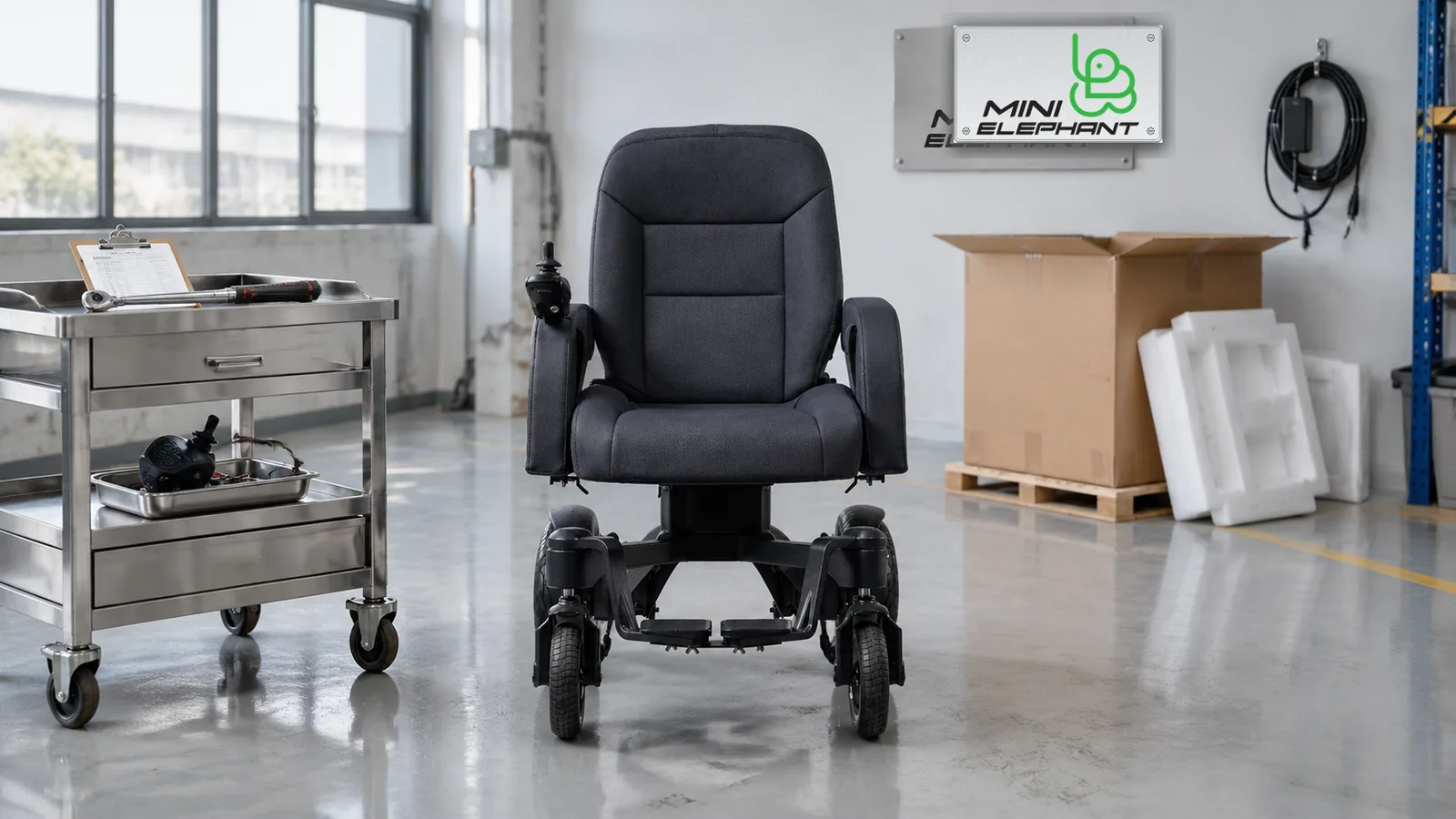
A workable electric wheelchair RMA process is decided before the first shipment, not after the first failure. Distributors need three documents in place: a return-authorization form that captures the serial number and fault evidence, a fault-classification table that separates transit damage from wear and user error, and a written responsibility matrix that names who pays freight, labour and parts in each scenario. Without those three, every electric wheelchair return becomes a negotiation instead of a procedure.
Why electric wheelchair returns cost more than other product returns
A returned smartphone fits in a padded envelope. A returned electric wheelchair is a 42 to 50 kg machine with a built-in lithium battery, a welded magnesium frame and two motorised wheels. The freight cost of moving an electric wheelchair back across an ocean often exceeds the value of the parts that failed.
That single fact should shape the entire process. For most electric wheelchair faults the correct answer is not "ship it back" but "diagnose it in the market, ship the module, and keep the unit with the user". Distributors who default to full-unit returns discover the economics after the second claim, when the freight invoice arrives and nobody has agreed who pays it.
There is a second reason to treat this as a process problem rather than a goodwill problem: a lithium battery that is built into the chassis, and cannot be removed by the user, changes which transport modes are available for the return leg. An electric wheelchair return that would be simple as a ground shipment inside one country becomes a regulated dangerous-goods question the moment it crosses a border.
The three documents that make an electric wheelchair RMA defensible
Document 1: the electric wheelchair return-authorization form
The form is the entry point for every electric wheelchair claim, and it should be impossible to open a case without it. Its job is to produce evidence that can be compared across shipments and across years.
Two fields are routinely left blank and both cause disputes: the controller fault indication and the storage history. A dealer who cannot say what the controller displayed is asking the factory to guess, and a factory that guesses will send the wrong module. Keep the electric wheelchair RMA form short enough that a service technician fills it in at the point of diagnosis, not a week later in the office.
Document 2: electric wheelchair fault classification
Classification of an electric wheelchair fault decides the remedy, the cost split and the warranty status at the same time. Six categories cover almost every real case.
The electric wheelchair fault classification must be recorded with evidence, not assigned by opinion. A distributor who labels a water-damaged controller as an early-life failure will win one claim and lose the commercial relationship; a factory that labels every claim as user error will lose the distributor. The value of a published classification table is that both sides argue about evidence instead of intent.
Document 3: the electric wheelchair responsibility matrix
Cost arguments are the slowest part of any electric wheelchair return, so put the split in writing before the first order.
Notice what is deliberately absent: percentages, credit periods, response-hour commitments and scrap thresholds. Those belong in the distribution agreement or the purchase contract, because they are commercial terms that differ by market and by volume. An article cannot invent them, and a distributor should never assume a default.
Local repair versus electric wheelchair return to factory
This is the decision that determines whether an electric wheelchair RMA programme is affordable. Make the test explicit rather than intuitive.
The third row is where most programmes fail. Because the battery in this product family is built in and not user-removable, an electric wheelchair with a suspected battery fault cannot simply be flown back on a passenger aircraft as a spare-part shipment. Plan for ground or sea transport on that route from the start, and quote the customer a realistic round-trip time instead of an air-freight time you cannot deliver. The module-supply side of that plan belongs in the spare parts planning guide.
Modular design is the technical enabler for local electric wheelchair repair. On the MiniRedone series the seat and chassis separate, so a technician can work on either half without a lifting frame, and the controller can be fitted to the left or right side. Both features exist for service access rather than for marketing, and both shorten the repair loop a distributor has to survive.
Step-by-step electric wheelchair RMA workflow
1. Capture the electric wheelchair failure at the point of diagnosis. Serial number, symptom, controller indication, photo or short video.
2. Classify the fault against the six published classes before contacting the factory.
3. Check warranty status against the delivery date on file, not against memory.
4. Submit the authorisation request with the completed evidence set.
5. Receive an authorisation number and a remedy decision: part, module, unit or credit.
6. For electric wheelchair part supply, confirm the exact revision. A controller revision that differs from the unit will fit but may not behave identically.
7. Record the labour hours and the parts consumed against the serial number.
8. Close the case with the returned part, the repair outcome and the final cause code.
9. Feed the cause code into the next purchase decision. A repeated castor failure is a specification issue, not bad luck.
Step nine is the one most programmes skip, and it is the only step that reduces future return volume. An electric wheelchair return that is closed without a cause code teaches nobody anything.
What an electric wheelchair evidence package should contain
Photographs decide most electric wheelchair disputes, so specify them instead of accepting whatever the dealer sends.
For electric wheelchair transit damage, the packaging photographs must be taken before the unit is fully unpacked. Distributors who want a written turnaround commitment should pair this evidence standard with an after-sales service SLA. Once the carton is discarded, a carrier claim becomes very hard to support, and the loss usually lands on the distributor.
How battery handling changes the electric wheelchair return route
The battery in this product family is a 16Ah lithium iron phosphate pack that is built into the chassis and is not designed to be removed by the end user. Three practical consequences follow.
- A full electric wheelchair return is normally a ground or sea movement, documented as dangerous goods where the mode requires it.
- Air movement is realistic for a spare module, not for a whole electric wheelchair with the pack installed.
- A damaged or swollen pack is not a normal return at all. It is a damaged-battery case with its own transport and reporting rules.
Distributors should hold the shipping documents that already accompany the product, including the battery test summary and the transport documentation, in the same file as the warranty paperwork. When an electric wheelchair return turns into a battery question, the file is already complete.
Electric wheelchair RMA metrics that show whether the programme works
Four numbers are enough to manage an electric wheelchair RMA programme. Chasing more produces reports nobody reads.
A distributor that closes most electric wheelchair claims by shipping whole units back has not built a repair capability; it has built a freight line. The share closed by part supply is the honest measure of service maturity.
Common mistakes in electric wheelchair return handling
- Opening an electric wheelchair case without the controller fault indication, then accepting whatever part arrives.
- Quoting the end user an air-freight return time for an electric wheelchair with an installed battery.
- Discarding the carton before photographing transit damage.
- Fitting a controller revision that does not match the electric wheelchair and creating a second, harder fault.
- Agreeing a goodwill replacement outside the written process, which sets a precedent the next claim will follow.
- Closing electric wheelchair cases without a cause code, so the same failure returns next quarter.
Each of these is a process gap rather than a technical one, and each is cheap to fix before the first shipment and expensive to fix afterwards.
Frequently asked questions
Does every electric wheelchair fault need an RMA number?
No, but every electric wheelchair claim that asks the factory for a part, a credit or a replacement does. Paid electric wheelchair part orders for consumables such as tyres or upholstery do not need authorisation, because no warranty decision is involved.
Can a distributor repair an electric wheelchair without sending it back?
Yes. For most bolt-on faults on an electric wheelchair, that is the intended route. The prerequisites are a trained technician, the correct module revision and a diagnosis recorded against the serial number, so that the same failure is traceable if it recurs.
Who pays electric wheelchair return freight for a warranty failure?
That depends on the fault class and on the terms in the distribution agreement, which is exactly why the responsibility matrix should be written before the first order instead of negotiated during the first claim.
How long should an electric wheelchair return take?
Any published electric wheelchair return figure has to match the transport mode actually available. A part-supply route and a full electric wheelchair sea return have very different timelines, and promising the faster one is a reliable way to lose a dealer's trust.
Can a damaged battery be shipped back?
A swollen or damaged lithium pack is handled as a damaged-battery case, not as routine freight. Treat it as a separate escalation with its own documentation and transport approval rather than folding it into the standard electric wheelchair RMA flow.
What should a distributor keep after closing an electric wheelchair case?
The completed form, the evidence photographs, the authorisation number, the parts consumed, the labour hours and the final cause code. That set is what makes a warranty dispute resolvable a year later, and what turns individual failures into a purchasing decision.
Building the process with a manufacturer
MiniElephant builds the MiniRedone series in Jiaxing, China: magnesium alloy frames, two 350W brushless hub motors, a 16Ah lithium iron phosphate pack and a 150 kg rated load, across ten models. Because the seat separates from the chassis and the controller can be mounted on either side, most electric wheelchair service work happens in the market rather than at the factory.
For distributors setting up an electric wheelchair return process, the useful starting point is a documented conversation about fault classes, evidence standards and the responsibility split, followed by a sample claim walked through end to end before the first container ships. Details of the model range are on the products page, and the pre-shipment and inspection material that usually sits beside an RMA procedure is in the import compliance document checklist and the pre-shipment inspection guide.
Ask for the electric wheelchair authorisation form, the fault-classification table and the spare-parts list as one package. A manufacturer that cannot supply all three in writing has not yet built an after-sales process, and the first electric wheelchair return will be the one that reveals it.
Related reading
Interested in MiniElephant Electric Wheelchairs?
Get a customized quotation and product recommendation from our export team. Response within 24 hours.