Electric Wheelchair Turning Radius Comparison: Indoor Maneuverability Guide
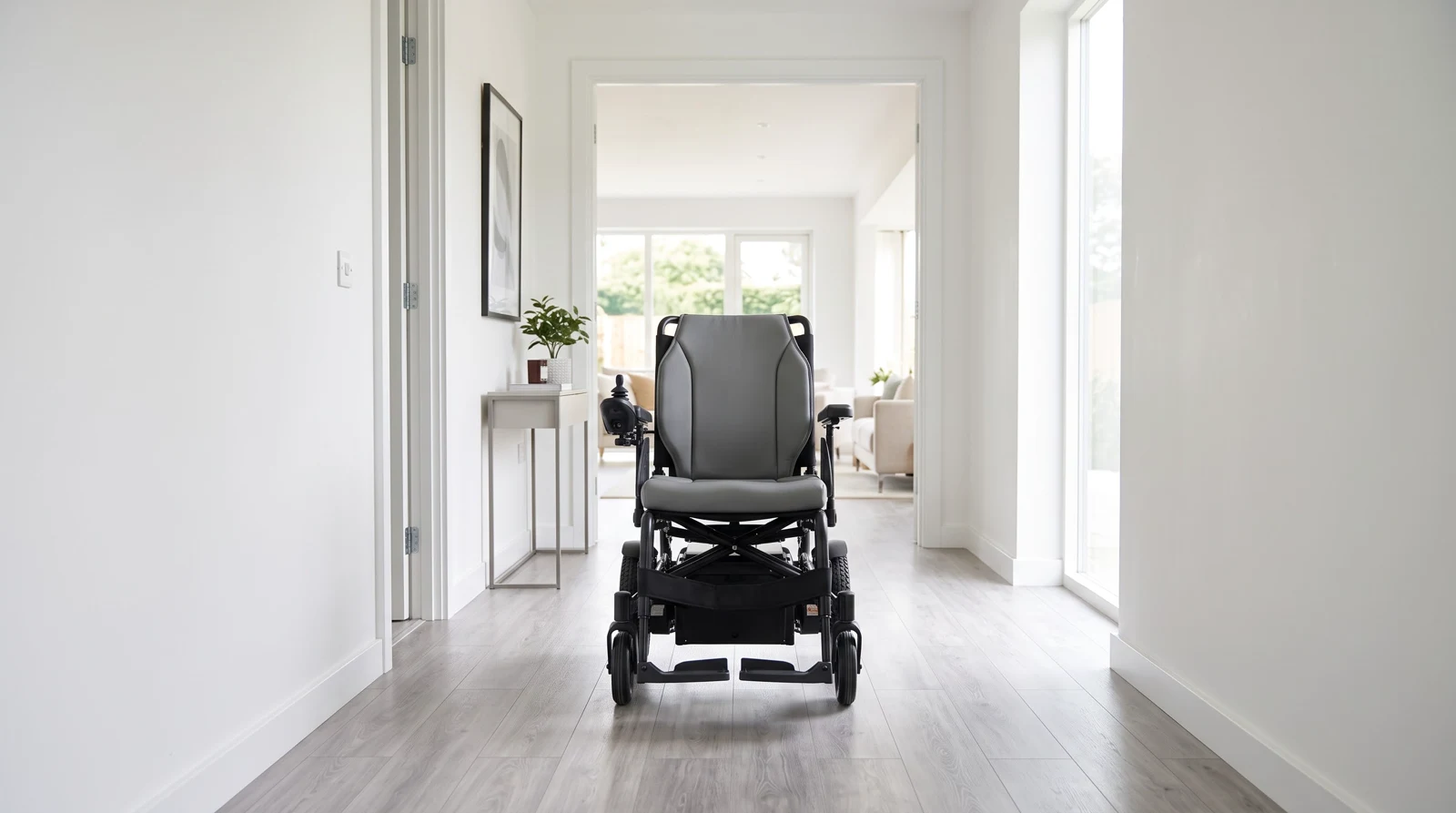
Electric Wheelchair Turning Radius Comparison: Indoor Maneuverability Guide
A compact turning radius is the difference between an electric wheelchair that works in a home and one that lives in the garage. For most indoor use, an electric wheelchair with a turning radius of 70 cm (27.5 in) or less will clear standard 80 cm doorways and complete a 180-degree turn in a typical bathroom; heavy-duty outdoor models with a radius above 90 cm (35 in) are a poor fit for tight interiors. This guide compares turning radius across electric wheelchair categories, explains why drive-wheel position matters more than frame size, and gives B2B buyers a measurement framework they can apply to real floor plans.
Background: Why the Turning Radius Defines an Electric Wheelchair's Indoor Usability
The turning radius — the distance from the center of the turning circle to the outermost point of the chair — determines whether an electric wheelchair can navigate doorways, bathrooms, corridors, and elevators. Industry data shows the average turning radius of electric wheelchairs on the market spans roughly 55 cm to 110 cm (22 to 43 in), a range that looks similar on paper but behaves very differently in a 10-square-meter apartment.
Price is not a reliable proxy for turning ability — a budget electric wheelchair model often copies rear-drive geometry from ten-year-old platforms, while newer mid-drive designs reach similar price points with a much smaller turning circle. This is why B2B buyers should evaluate each electric wheelchair on measured radius rather than on category or price band alone.
Standard interior dimensions set the benchmark: most residential doorways are 80 cm (31.5 in) wide, ADA-compliant clear door width is 81 cm (32 in), and ADA requires a 152 cm (60 in) turning space for a wheelchair to complete a 180-degree turn. A hallway of 91 cm (36 in) is the ADA minimum. When the turning radius of an electric wheelchair exceeds these dimensions, the user must make three-point turns in every room — a tiring, frustrating experience that erodes the independence the chair was bought to provide.
For B2B buyers, turning radius is also a returns driver. Distributors report that "doesn't fit my home" is one of the most common post-purchase complaints in the folding electric wheelchair segment. Matching radius to floor plan reduces returns, service calls, and negative reviews.
Evaluation Criteria: Five Factors That Decide Real-World Maneuverability
|-----------|---------------|----------------|
The drive-wheel position is the strongest predictor of turning ability. An electric wheelchair with mid-wheel drive and counter-rotation can spin on the spot with a turning radius close to its wheelbase; a rear-wheel drive model with the same footprint typically needs 15-25 cm more space to turn. Front-wheel drive sits between the two and is often chosen for its curb-climbing ability, not its turning circle.
Comparison: Turning Radius by Electric Wheelchair Category
|----------|------------------------|---------------|------------|
The table above is a starting point, but the actual turning radius of each electric wheelchair should be verified with the supplier before quoting it to a client. For a typical home environment, the 65-80 cm band is the sweet spot. Chairs in this range fit through standard doorways with 5-10 cm of clearance on each side, can turn in a 150 x 150 cm bathroom, and still track well on outdoor paths. Ultra-compact chairs under 65 cm trade ground clearance and wheel size for apartment access, while outdoor models above 85 cm should be reserved for users who rarely enter narrow interiors.
Drive Position and Its Effect on Turning
- Rear-wheel drive: The most common configuration, with drive wheels at the back. It is stable and efficient, but the rear wheels swing wide during turns, pushing the effective turning radius 15-25 cm larger than a mid-wheel drive chair of similar size.
- Mid-wheel drive: Drive wheels sit under the seat, usually with anti-tip casters front and rear. Counter-rotation lets the chair pivot in place, producing the smallest turning radius in its class — often 60-70 cm even on a full-size frame.
- Front-wheel drive: Drive wheels at the front pull the chair forward, which improves obstacle climbing. Turning radius is moderate, and the drive wheels can interfere with footrest swing space.
When comparing electric wheelchair drive options, ask whether the controller includes a precision turning mode; a low-speed creep profile tuned for indoor use is a strong sign the electric wheelchair was designed around tight spaces.
B2B tip: Do not compare turning radius figures alone — always ask for the drive configuration. A rear-wheel drive chair with a published radius of 75 cm will feel wider in a hallway than a mid-wheel drive chair with the same number, because the effective swept path during a turn is larger.
How to Measure Doorways, Hallways, and Bathrooms
1. Measure the narrowest doorway the chair must pass through, including door frames, not just the opening.
2. Measure the smallest room where the user must turn around (usually the bathroom) in both directions.
3. Check elevator dimensions if the user lives in an apartment building; a 90 cm wide elevator cabin is comfortable only for chairs under 80 cm radius.
4. Add 5-10 cm clearance on each side of every doorway for user confidence and caster drift.
5. Compare the result against the turning radius of the electric wheelchair — not its width. Width alone is misleading, because a chair turns through space, not just along a line.
A practical rule used by mobility dealers: if the turning radius of the electric wheelchair is smaller than the width of the smallest room minus 30 cm, the user can turn around in that room without three-point maneuvers.
Decision Framework for B2B Buyers
1. Profile the home first. Doorway width, bathroom size, corridor width, and elevator cabin — collect at least three measurements before shortlisting any electric wheelchair models.
2. Choose the 65-80 cm band as the default electric wheelchair turning radius for general home use; go under 65 cm only for small apartments or frequent travel; go above 85 cm only for outdoor-dominant use.
3. Prioritize drive configuration over price. Mid-wheel drive with a 62 cm turning radius will outperform a cheaper rear-drive chair with a 78 cm radius in the same apartment.
4. Verify the radius yourself. Ask the supplier for the measurement method; some datasheets quote the chassis radius without armrests, footrests, or joystick, which can understate the real swept path by 5-10 cm.
5. Offer a fit-guarantee tier for first-time buyers. In the folding electric wheelchair segment, distributors who match radius to floor plan report return rates below 3%, while those who sell on range and speed alone see returns climb past 8%.
FAQ: Electric Wheelchair Turning Radius
Q: What is a good turning radius for an electric wheelchair used at home?
A: For most homes, 70 cm or less is comfortable; 65-80 cm covers standard doorways and bathroom turns. If the user lives in a small apartment, aim for 60-65 cm or a mid-wheel drive model that turns in place.
Q: Why does a mid-wheel drive electric wheelchair turn more tightly than a rear-wheel drive one?
A: Mid-wheel drive chairs pivot around the center of the wheelbase, and counter-rotation lets the two drive wheels spin in opposite directions, so the chair rotates on the spot. Rear-wheel drive chairs pivot around the rear axle, sweeping the front of the chair through a much larger arc.
Q: Can a heavy-duty electric wheelchair with a 100 cm turning radius be used indoors?
A: Only in large open-plan homes. In standard doorways and bathrooms it will require three-point turns and often get stuck. Heavy-duty models are better paired with outdoor use or homes with wide corridors and no tight corners.
Q: How is turning radius measured, and why do datasheets vary?
A: The official measurement is from the center of the turning circle to the outermost point of the chair during a full turn. Datasheets vary because some quote the chassis only, without armrests, footrests, or joystick. Ask the supplier for the measurement method before comparing models.
Q: Does a smaller turning radius make an electric wheelchair less stable?
A: Not by itself. Stability depends on wheelbase, track width, center of gravity, and anti-tip design. Some ultra-compact chairs do feel tippy outdoors, so confirm the anti-tip casters and hill-climbing rating if the electric wheelchair will be used both indoors and outdoors.
Model Notes: What to Look for in a Compact Electric Wheelchair
When shortlisting compact models, B2B buyers should verify the turning radius against the supplier's measurement method, the drive configuration, and the load rating. For example, the MiniElephant MiniRedone series is a magnesium-alloy folding electric wheelchair with a 150 kg load capacity and a 30 km range — a strong candidate for the 65-80 cm comfort band if the supplier confirms the radius and drive geometry on the datasheet. Compare it against other brands' published figures before deciding; the right choice depends on the user's floor plan, not the spec sheet alone.
Interested in MiniElephant Electric Wheelchairs?
Get a customized quotation and product recommendation from our export team. Response within 24 hours.