Electric Wheelchair vs Manual Wheelchair: 2026 B2B Buyer Guide
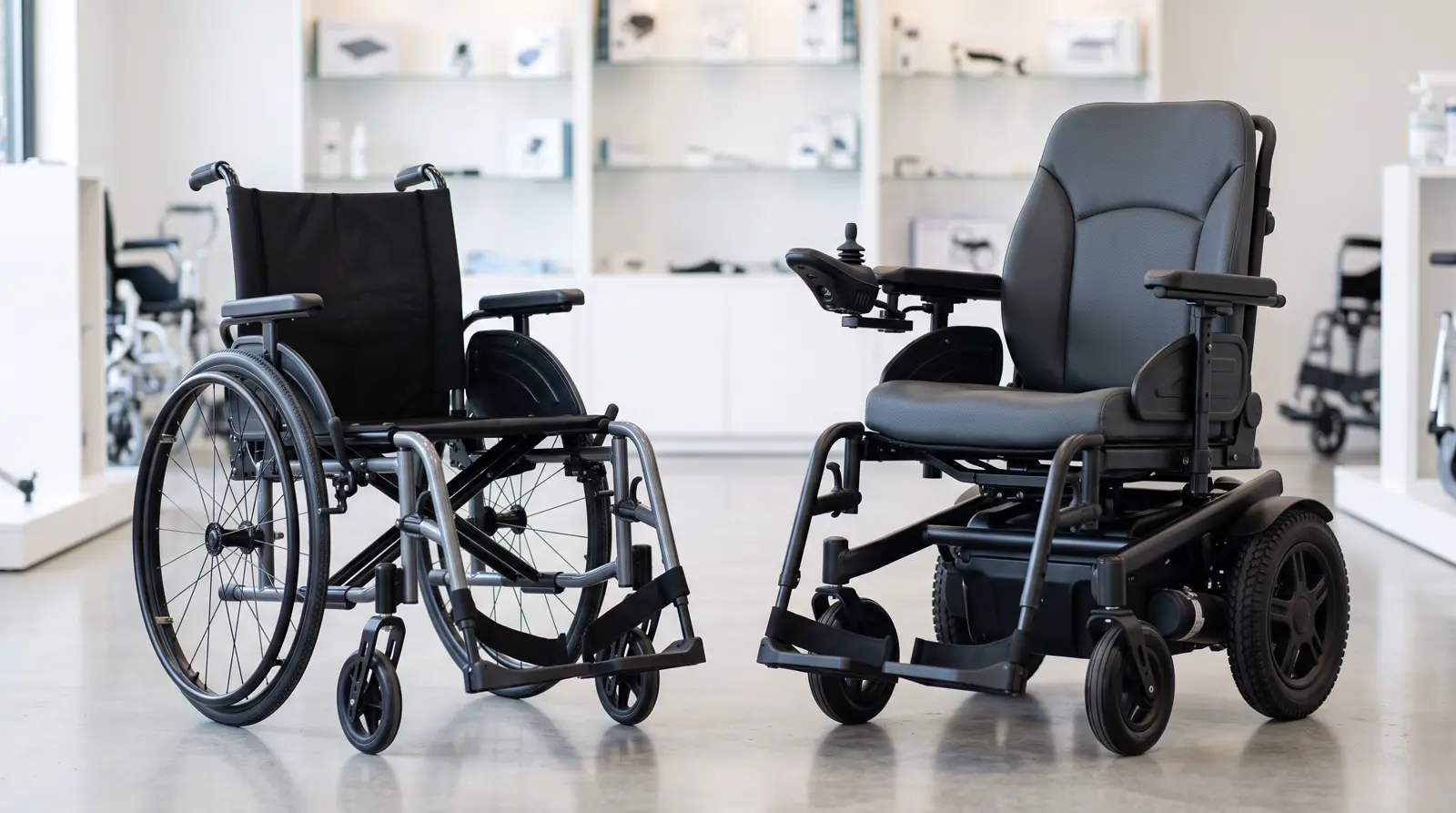
Why the Manual vs Electric Decision Is a B2B Stocking Question
The single most important takeaway: the choice between an electric wheelchair and a manual wheelchair is not a product detail — it is a portfolio decision that determines which customer segments you can serve, how much logistics cost you carry, and where your margin sits. Most B2B distributors serve both segments, and the fastest-growing share of the market belongs to the electric wheelchair category.
The global wheelchair market is split roughly 60/40 between manual and powered models by unit volume, but the revenue balance has been shifting toward electric for a decade. Industry estimates value the global power wheelchair market at USD 5 billion to 6 billion in 2025, with annual growth of 7% to 9%, while the manual wheelchair market grows in the low single digits. The World Health Organization estimates that around 80 million people worldwide need a wheelchair, and only a fraction of them currently have one — a structural tailwind for both categories.
For a B2B buyer, the electric wheelchair segment offers higher average order value, more repeat demand for batteries and spare parts, and stronger differentiation. Manual wheelchairs offer a lower entry price, simpler logistics, and high volume in budget markets. Understanding the real differences — not the marketing differences — decides which mix you stock.
Evaluation Criteria: Five Factors for Comparing an Electric Wheelchair with a Manual Wheelchair
When a procurement officer asks you to justify a recommendation, score every candidate against five criteria:
1. End-user mobility — Does the user have the upper-body strength and endurance to self-propel a manual chair for the distances they travel daily? For users with limited strength, an electric wheelchair removes the physical barrier entirely.
2. Use environment — Short, smooth, indoor routes favor light manual models; longer distances, ramps, and outdoor terrain favor an electric wheelchair.
3. Total cost of ownership — A manual chair's purchase price is lower, but an electric wheelchair's battery and motor costs add ongoing expense, while caregiver labor savings often offset that.
4. Logistics and regulation — Lithium batteries on an electric wheelchair trigger UN38.3 documentation and shipping constraints; a manual wheelchair ships as ordinary cargo.
5. After-sales complexity — An electric wheelchair needs trained service for motors, controllers, and batteries; a manual wheelchair is serviceable with basic tools.
Head-to-Head: Electric Wheelchair vs Manual Wheelchair
|---|---|---|
A few numbers from this table are worth memorizing. Self-propelling a manual wheelchair consumes roughly 2 to 3 times the energy of walking the same distance, which is why users with limited stamina abandon manual chairs within months. Caregiver pushing is one of the leading causes of work-related back injuries in elderly care settings, and replacing caregiver-pushed manual chairs with an electric wheelchair measurably reduces staff injury claims. On the cost side, charging an electric wheelchair costs only a few cents per full charge at typical electricity rates — battery running costs are almost negligible compared with the labor costs of manual assistance.
Cost Analysis: Total Cost of Ownership for B2B Buyers
Purchase price is only the first line. For a distributor comparing an electric wheelchair with a manual wheelchair, model three to five years of ownership:
- Manual wheelchair: low acquisition cost and minimal spares, but recurring labor cost whenever a caregiver pushes the user. In institutional settings, staff time is the largest hidden line item.
- Electric wheelchair: higher acquisition cost, battery replacement every 2 to 4 years (typically USD 150-400 wholesale), plus motor and controller service — but the user drives independently, eliminating most caregiver labor.
- Resale and upgrade cycle: manual chairs are often replaced every 3 to 5 years due to wear; an electric wheelchair's battery and electronics are the natural upgrade path, letting you sell replacement batteries and controllers as recurring revenue.
In many home-care and institutional segments, the total cost of ownership of an electric wheelchair converges with, or falls below, a manual chair within two to three years once labor is priced in. That is why procurement departments increasingly standardize on electric — and why distributors who ignore the electric wheelchair category lose the most valuable tenders.
Decision Framework: Which Wheelchair Should Your Catalog Stock?
Use this four-step framework when building or updating your range:
1. Segment by end user. Elderly users with reduced upper-body strength, MS and Parkinson's patients, and facility residents are electric-first customers. Budget markets with able-bodied attendants and flat indoor environments still buy manual units in volume.
2. Match distance and terrain. If the user travels more than about 500 meters per day, crosses ramps, or goes outdoors, an electric wheelchair is the defensible recommendation.
3. Price the total package. For an electric wheelchair, quote the chair, spare battery, and charger as a bundle; for a manual chair, quote spares and cushions. This positions you as a solutions partner rather than a box mover.
4. Plan logistics early. Battery regulations are the biggest electric wheelchair shipping variable. Confirm UN38.3 certificates and lithium battery watt-hour ratings before quoting freight, and keep manual models in your range for air-freight orders where batteries add cost and delay.
FAQ: B2B Questions About Electric and Manual Wheelchairs
Q: Which type should a new distributor stock first?
A: Most successful importers start with a small electric wheelchair lineup for the growth segments and a manual lineup for volume and entry-price markets. The mix depends on your target customers; institutional and elderly-care buyers skew electric, while government and budget tenders often specify manual chairs.
Q: Can a manual wheelchair be converted into an electric wheelchair?
A: Yes — add-on drive wheels and power-assist systems exist. But conversions add weight, rarely integrate as well as a purpose-built electric wheelchair, and can complicate certification and warranty. For B2B consistency, factory-built units are usually the safer stock item.
Q: How much faster and farther is an electric wheelchair?
A: Most electric wheelchair models top out at 6 km/h (4 mph) to comply with indoor safety standards, roughly matching a brisk walk, and cover 15 to 50 km per charge. A manual wheelchair's speed and range depend entirely on the user's strength.
Q: Do electric wheelchairs need more maintenance than manual models?
A: Yes, but the pattern is predictable: batteries every 2 to 4 years, brake and motor checks annually, and controller diagnostics when faults appear. Manual wheelchairs mainly need wheel, brake, and upholstery service. Distributors should stock battery and controller spares to capture after-sales revenue.
Q: Which brands should a B2B buyer compare?
A: Premium names like Permobil, Invacare, and Sunrise Medical dominate the high end. Established Chinese manufacturers — MiniElephant among them — offer comparable electric wheelchair specifications at substantially lower wholesale prices, which is why they increasingly appear in importers' catalogs.
The B2B Bottom Line
The electric wheelchair category is where the market growth, the margin, and the recurring revenue live; manual wheelchairs remain a volume staple that no full-line distributor can ignore. Build a catalog that covers both, segment by end user and terrain, and price the total cost of ownership rather than the first invoice. When you recommend an electric wheelchair, verify battery documentation and service support; when you recommend a manual wheelchair, confirm the user can actually self-propel it. That discipline turns a simple product choice into a repeatable B2B selling system.
**Need electric wheelchair and manual wheelchair options for your catalog?** [Contact the MiniElephant export team](https://www.semwheelchair.com/contact) for specification sheets, wholesale pricing, and battery documentation on both categories.
Interested in MiniElephant Electric Wheelchairs?
Get a customized quotation and product recommendation from our export team. Response within 24 hours.