Electric Wheelchair Fleets in Care Homes and Nursing Facilities
The short answer
Care homes and nursing facilities do not buy an electric wheelchair the way a family does. They buy availability: an electric wheelchair that is charged, clean, correctly assigned to a resident, and serviceable without taking a staff member off the floor for a day. The procurement decision therefore turns on four things an individual buyer never asks about: how many electric wheelchairs the building actually needs at peak, where they are charged and stored, who is trained to hand them over, and what evidence exists when something goes wrong.
This guide sets out a facility-side buying framework for electric wheelchair fleets: sizing the requirement, planning charging and storage, training staff, recording handovers, and keeping uptime predictable. It is written for care home operators, nursing facility administrators, rehabilitation centres and the distributors who supply them.
Why a facility buys differently from a household
A household buys one electric wheelchair for one person and accepts a compromise. A facility buys a small electric wheelchair fleet that must fit many people over several years, and the compromises compound. A chair that is comfortable for one resident but slow to adjust will sit unused while staff queue for the one electric wheelchair that adjusts quickly. A model with a proprietary controller will strand the building when the local technician cannot source a replacement.
Three operational differences drive every later decision:
- Utilisation beats specification. The useful question is not which electric wheelchair has the best headline range, but how many hours per day each electric wheelchair is actually in use and what blocks it from being used.
- Turning over users is routine. Each new resident may need a different seat position, armrest height and speed setting. Adjustment time is a real staff cost.
- Downtime is visible. In a private home a broken electric wheelchair is an inconvenience. In a facility it is a safeguarding and dignity issue that appears in care records.
Step 1: Size the electric wheelchair requirement from peak demand, not from bed count
Bed count is the wrong denominator. Facilities that size a fleet as a fixed fraction of beds usually end up with idle units in one wing and a waiting list in another.
Build the number from observed demand over two weeks:
- Count residents who currently use a wheelchair for indoor or outdoor mobility, and split them by whether they self-propel, need attendant pushing, or need powered mobility.
- Record the times of day when powered electric wheelchair demand peaks, usually morning personal care, meal service and afternoon activity.
- Measure how long each use lasts, including the trip to the garden, the minibus transfer or the appointment run.
- Subtract units that are out of service for charging, cleaning or repair at any given moment.
The last point is the one facilities underestimate. An electric wheelchair that needs four to six hours to charge is not available for part of every day. If your building runs a single charging point in a corridor, the realistic availability of a unit is lower than its nominal fleet count. Plan a spare ratio, and keep at least one electric wheelchair that can be substituted without rescheduling.
A simple working rule: size to peak concurrent need plus one serviceable spare per ten units in use. Adjust once you have real utilisation data rather than guessing on day one.
Step 2: Design the charging and storage room before ordering
Most electric wheelchair problems in care settings are energy and space problems, not product problems.
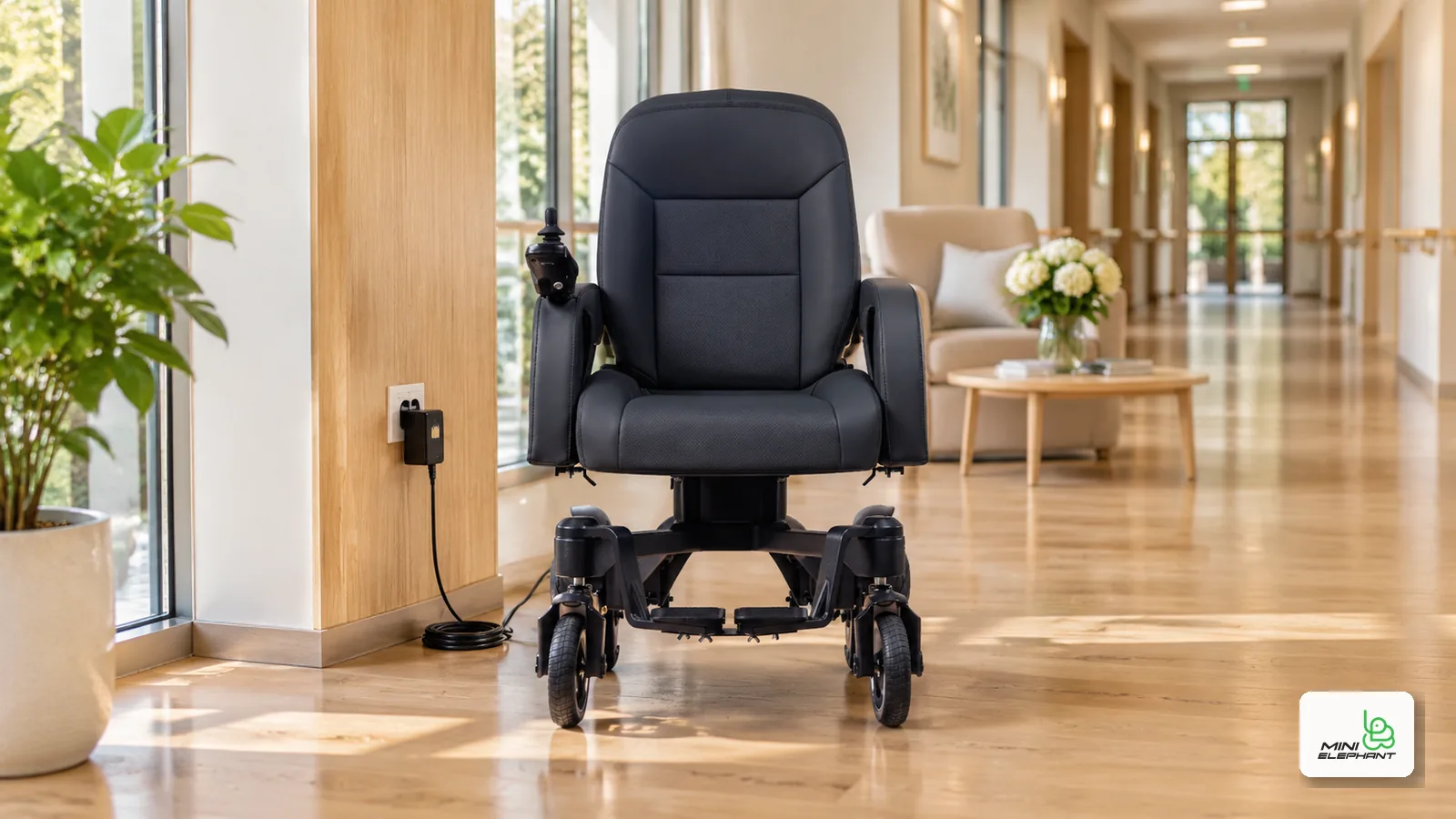
Charging. Each electric wheelchair needs a designated charging position with a socket that is not shared with cleaning equipment. Charging an electric wheelchair in a corridor, against a fire door, or in a resident's room creates a trip hazard and blocks evacuation routes. A dedicated electric wheelchair charging bay with cable management and a signed log removes both problems.
Battery behaviour. The MiniRedone range uses a 16 Ah lithium iron phosphate battery built into the chair, charged in four to six hours from a standard supply. The battery is not designed for user removal, so the chair must be brought to the charger rather than the battery brought to a desk. That single fact determines the room layout: you need floor space for the chair plus clearance to walk around it, not a shelf of batteries.
Storage. Folded storage is useful only if staff fold correctly. Record the folded dimensions for the models you shortlist and check them against your actual doorway, lift and store-cupboard measurements before you commit. An electric wheelchair that folds to a size that does not fit the linen cupboard will be stored unfolded in a corridor. Compare folded dimensions and lifting weight across shortlisted models before you sign.
Step 3: Decide who is allowed to adjust the electric wheelchair
Adjustment authority is a governance question disguised as a technical one. Some facilities let any senior carer change the seat height of any electric wheelchair, armrest width and speed limits. Others lock every setting and route requests to a maintenance technician. Both approaches fail for different reasons: the first produces settings no one can reproduce, the second produces a queue.
A workable middle position:
- Define a short list of adjustments staff may make without authorisation: armrest height, footrest position, speed profile selection within an approved band.
- Require a record for anything that changes the geometry of the seat or the maximum speed.
- Keep the controller configuration under technician control, with a written note of the current setting per unit.
On the MiniRedone models the controller can be mounted on the left or right and the seat separates from the chassis, which shortens both adjustment and repair work. Mention that to your maintenance lead early: a chair that can be split into two manageable parts changes what "we can fix it in-house" means.
Step 4: Train staff on handover, not only on driving
Driving a powered electric wheelchair is the easy part. The failure mode in facilities is handover: the next shift does not know that unit 3 pulls to the left, that resident A needs the speed limiter on, or that the footrest was changed yesterday.
Build a one-page handover card per electric wheelchair, kept with the chair, covering:
- Assigned resident and approved settings
- Tyre pressure and brake check result at the start of each shift
- Charging time logged, and who connected it
- Faults observed, in plain language, with the date
- Who last adjusted the chair and what changed
Then train in two tiers. Tier one covers safe use, charging, cleaning and reporting — everyone who moves a chair. Tier two covers adjustment, battery care and basic fault isolation — a named group of two or three people per building, so cover exists during leave. A dealer-facing version of the same ladder is set out in our electric wheelchair dealer training guide.
Step 5: Cleaning between users is a specification, not a chore
Shared electric wheelchairs move between residents, so cleaning is a cross-infection control step. Agree in writing which surfaces are cleaned between users, which product is approved by your infection control lead, and how long the chair is out of use afterwards. Seat and backrest upholstery, armrests, joystick and any attendant control are the high-contact points.
Ask the electric wheelchair supplier two specific questions before ordering: what the upholstery is made from, and what cleaning agents the manufacturer has tested it against. An electric wheelchair whose covering degrades after a year of ward-grade cleaning becomes an unplanned replacement, and replacement cycles are what wreck a facility budget.
Keep cleaning records with the handover card. When a facility is inspected, the question is rarely whether the electric wheelchair was cleaned; it is whether the building can show that it was. Material care between users is covered in more detail in our upholstery cleaning and daily care guide.
Step 6: Make maintenance and uptime part of the contract
Facilities should buy electric wheelchair service the same way they buy the chair: with defined obligations. At minimum, agree:
MiniElephant supplies electric wheelchairs with a five-year frame warranty and three-year cover on controller, battery and motor, together with documentation for dealer and facility records. Confirm the exact terms for your order in the sales contract rather than relying on a brochure.
A facility that cannot get an electric wheelchair footrest replaced in a week will cannibalise a second chair, and the fleet quietly shrinks. Track mean time to repair per electric wheelchair and review it quarterly with your supplier. What to put in writing is set out in the after-sales service SLA guide, and which parts to stock is covered in the spare parts planning guide.
Step 7: Keep an audit trail that survives staff turnover
Care providers are inspected on records, and every electric wheelchair is part of that record. Keep one file per electric wheelchair containing the purchase documents, serial number, warranty certificate, service history, adjustment log, cleaning log and any incident report. When a resident's family asks what happened to a chair, or when an insurer asks for evidence, that file answers the question in minutes instead of days.
Digital is better than paper only if staff actually use it. A shared spreadsheet with one row per electric wheelchair and a photo field for damage is sufficient for a fleet of ten to twenty electric wheelchairs, and it is far more likely to be maintained than a formal asset system nobody opens.
Step 8: Budget the whole cycle, not the purchase
A facility budget that covers only the purchase price understates cost. Include charging, cleaning materials, consumables, technician time, training hours and the replacement of at least one unit per cycle. Compare electric wheelchair models on cost per resident-day of availability rather than on invoice price, because a cheaper electric wheelchair that is unavailable two days a week is the more expensive option.
Model three scenarios — conservative, expected and peak-season — and keep the spare ratio explicit in each. When a funding application or board paper asks why the fleet needs another electric wheelchair, that model is the answer. For a model-by-model view of running costs, see the cost of ownership comparison.
Procurement checklist for facility buyers
- Peak concurrent demand measured over at least two weeks, not estimated from bed count
- Folded and unfolded dimensions checked against doorways, lifts and store rooms
- Dedicated charging positions with cable management and a signed charging log
- Named staff authorised to adjust settings, with a written record of changes
- Handover card per unit, completed each shift
- Cleaning protocol agreed with infection control, with records retained
- Written service obligations: response time, spare parts, consumables, warranty
- One file per unit covering purchase, serial, service, adjustment and incident records
- Total cost model including charging, cleaning, training and replacement
Frequently asked questions
How many electric wheelchairs does a 60-bed care home need?
There is no universal ratio. Measure peak concurrent use over two weeks, subtract units out of service for charging, cleaning or repair, then add one spare per ten active units. Facilities that skip the measurement phase usually buy too few adjustable units and too many basic ones.
Can residents charge their own electric wheelchair in their room?
Only if the room has a suitable socket and the cable route does not cross a walkway or block the door. Many facilities prefer a supervised charging bay because it keeps evacuation routes clear and makes the charging log accurate.
Is a folding electric wheelchair better for a care home?
Folding helps where storage is genuinely tight or where electric wheelchairs travel in a minibus. It is not automatically better: folding mechanisms add parts that can loosen, and staff must be trained to fold and unfold safely. Check the folded dimensions against your building before deciding.
Who should service the fleet?
Either a trained in-house technician or the supplying dealer, but the split must be written down. Facilities that keep tier-one tasks in-house — tyre pressure, cleaning, visual brake checks, handover records — and route controller, motor and battery work to the supplier get the best uptime per pound spent.
Do we need a spare electric wheelchair?
Yes. One serviceable spare per ten units in use, and for smaller fleets at least one. Without a spare, any repair becomes a scheduling problem that displaces a resident's mobility.
Where MiniElephant fits
MiniElephant builds the MiniRedone range of folding electric wheelchairs: magnesium alloy frames, two 350 W brushless hub motors, a 16 Ah lithium iron phosphate battery, 150 kg maximum load and roughly 30 km of range, with net weights of 42 to 50 kg depending on model. Seat and chassis separate for maintenance, the controller can be mounted left or right, and the frame carries a five-year warranty with three-year cover on controller, battery and motor.
For care home groups, rehabilitation providers and the distributors who serve them, we can supply electric wheelchair specifications, dimensions, documentation packs and dealer training material in a single file so facility procurement teams can compare options without chasing data. Write to johnson@semwheelchair.com or message +86 13819098967 on WhatsApp with your bed count, building constraints and current fleet mix, and we will respond with a shortlist and a sizing worksheet.
Related reading
- Electric Wheelchair Payment Risk: Escrow, Cards and Contracts
- Electric Wheelchair Fleet Telematics: GPS Tracking for Rentals
- Electric Wheelchair Dealer Marketing: Lead Generation Playbook
- Electric Wheelchair Distribution Agreement: Territory Terms
More in this topic: Dealer & Distributor Operations · All articles
MiniRedone models
Interested in MiniElephant Electric Wheelchairs?
Get a customized quotation and product recommendation from our export team. Response within 24 hours.