Electric Wheelchair Armrests: Fixed vs Adjustable B2B Review
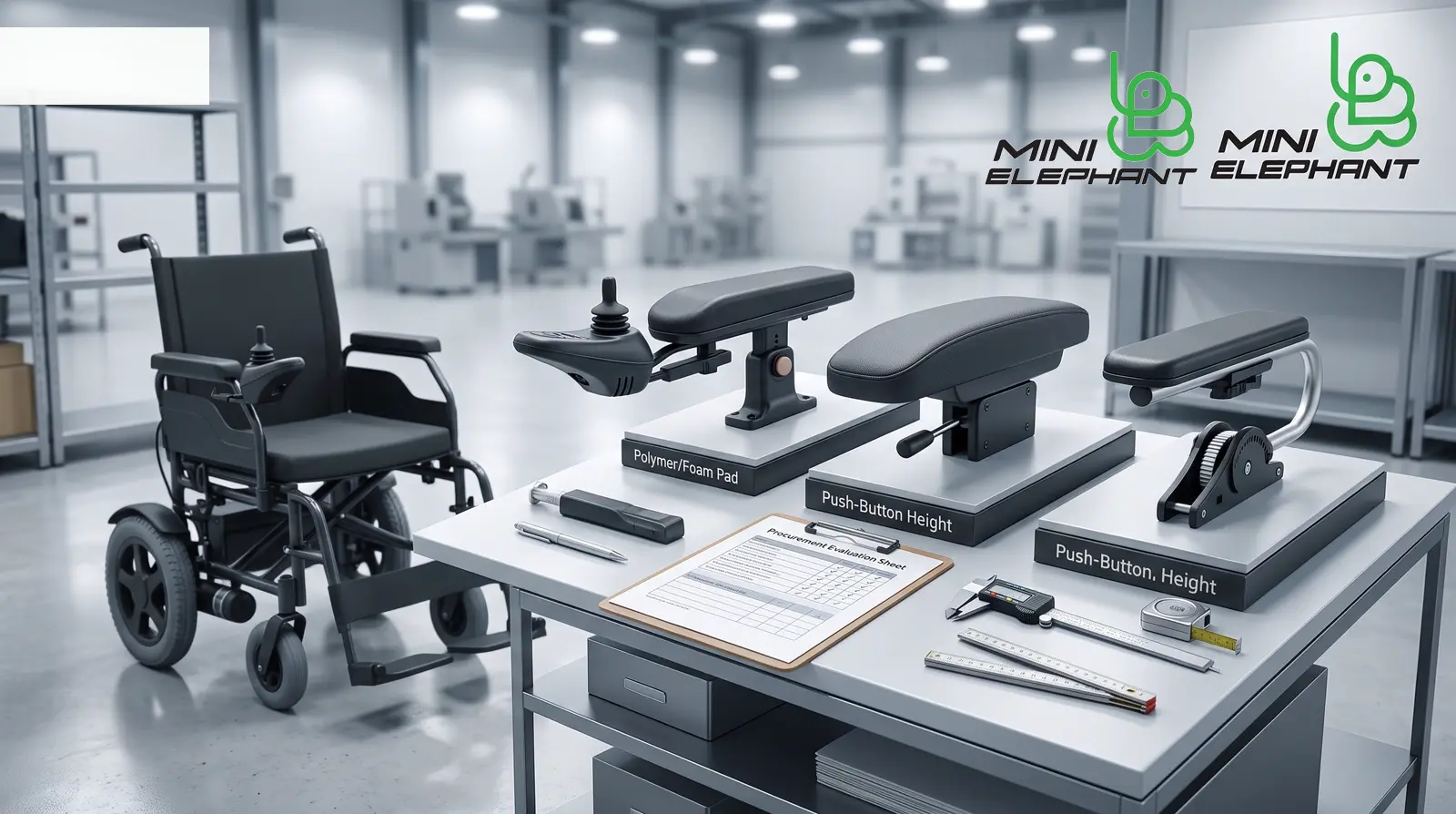
The practical answer: the best electric wheelchair armrest is not automatically the most adjustable one. For B2B buyers, the correct choice is the armrest configuration that matches the intended transfer method, seating width, control location and service plan—and that is described clearly enough to inspect before shipment. A fixed armrest can be the simplest baseline; an adjustable or flip-back design can add user-fit flexibility, but also adds interfaces that buyers should specify and test.
Background: why electric wheelchair armrests deserve a separate review
An electric wheelchair armrest supports forearm positioning, can influence access to a joystick, and may affect how a user approaches a desk, dining table or transfer surface. It is therefore more than a cosmetic trim item. In a typical sourcing review, armrest questions sit alongside seat width, controller position, frame geometry and cushion selection.
Catalogues commonly present three electric wheelchair armrest formats: fixed padded supports, height-adjustable supports, and flip-back or removable supports. Their names alone do not describe the buyer outcome. Two units with the same label can differ in pad length, lateral clearance, adjustment increments, hinge feel, fastener finish and compatibility with side-mounted controls. This comparison uses observable criteria rather than a brand ranking. It is commercial purchasing guidance, not medical advice, a legal opinion or a destination-market approval guarantee.
Electric wheelchair armrest evaluation criteria
Review an electric wheelchair armrest against these five factors before comparing quotations:
1. Transfer and table access. Determine whether the buyer needs a fixed boundary, a flip-back path, or a removable side. Ask for a demonstration rather than assuming the product name explains the movement.
2. Adjustment range and repeatability. Record the lowest and highest usable pad height, the increment or indexed positions, and whether adjustment can be secured without free play.
3. Pad support and finish. Compare usable pad length and width, edge finish, surface cleanability and the attachment method. Confirm the relevant material description from the supplier rather than treating a product photo as proof.
4. Control and seating integration. An electric wheelchair joystick, swing-away mount, seat cushion and side guard can all change usable elbow room. Evaluate the complete configured unit.
5. Inspection evidence and spare-part traceability. Request configuration photos, part identifiers, fastener information and a written change-control process for the approved sample.
Main comparison: fixed, adjustable and flip-back electric wheelchair armrests
|---|---|---|---|
Fixed armrests: when a simple electric wheelchair specification is useful
A fixed electric wheelchair armrest normally has the fewest adjustment points. For a buyer standardizing one seating configuration, that can make inspection simpler: the drawing or approved sample can identify pad length, pad width, mounting location and the control-side arrangement. A fixed design may also be appropriate where the buyer prioritizes a consistent outer width and does not require a side-opening action.
The trade-off is limited adaptation after delivery. A fixed electric wheelchair armrest should not be selected solely because it looks compact in a catalogue. Buyers should check the actual usable space between armrests, any contact point with a cushion or side panel, and whether the joystick location changes the right- or left-side experience. A measured photo with a ruler is more useful than an unlabelled product image.
Height-adjustable armrests: quantify the electric wheelchair range
An adjustable electric wheelchair armrest can support a more structured fit discussion, but only if the range is measurable. Ask suppliers to state pad-top height from the seat reference plane at the lowest and highest positions, in millimetres, and to show how the position is retained. If a quotation shows a range such as 25–75 mm, the buyer should confirm the reference points, whether every position is usable, and whether an option package changes the range.
For procurement comparison, distinguish adjustment range from adjustment quality. The electric wheelchair armrest should stay aligned with the seat, should not interfere with a control mount, and should be checked under normal hand pressure. Do not publish a universal acceptable tolerance, cycle count or load threshold unless it has been agreed in the purchase contract and verified for the selected configuration. Those commercial acceptance criteria belong in the buyer-manufacturer quality agreement.
Flip-back or removable armrests: evaluate the entire electric wheelchair path
A flip-back electric wheelchair armrest is often evaluated for access, but the buyer should review the full motion path. Does the pad lift clear of the seat? Does it stop at a stable position? Is there a latch, and can it be operated as intended in the approved configuration? Where a controller is mounted on the same side, does it move with the armrest, remain in place, or require a separate bracket? These are configuration questions, not details to leave to a generic brochure.
A removable electric wheelchair armrest can introduce a different operational question: how will the detached part be identified, stored and reinstalled? If spare parts are planned, request the part number, attachment hardware and a photo of the installed orientation. The local importer and relevant advisers remain responsible for determining applicable destination-market obligations.
A B2B decision framework for electric wheelchair armrests
Use this short process to make an electric wheelchair comparison repeatable:
|---|---|---|---|
This approach helps an electric wheelchair buyer compare like with like. It also prevents a common sourcing error: approving a sample with one armrest style while the final order description only says “armrest.” The written record should define model or SKU, left/right orientation, pad type, adjustment feature, controller relationship, appearance reference, packaging considerations and open items. Sampling method, acceptance thresholds, remedies, costs, response times, price and warranty terms should be negotiated separately in the purchase contract.
Practical electric wheelchair comparison tips
- Ask for a short video that shows the electric wheelchair armrest through its full stated movement, with the configured controller visible.
- Compare dimensions from the same reference plane; a pad-top height and a frame-tube height are not interchangeable.
- Review one electric wheelchair with the actual cushion, joystick mount and side accessories installed. A component-only photo cannot prove clearance.
- Create a left-side/right-side checklist. An electric wheelchair may use different control or mounting arrangements by side.
- Keep the approved sample, quotation revision and inspection notes linked by a model/SKU and date. Written change control protects both buyer and manufacturer when an option changes.
MiniElephant Electric Wheelchair is one supplier option B2B buyers can contact to discuss configured product information. Jiaxing Small Elephant Medical Technology Co., Ltd can be reached through the site inquiry form or at johnson@semwheelchair.com. Buyers should still validate the selected electric wheelchair configuration, commercial terms and local compliance responsibilities for their own market.
FAQ: electric wheelchair armrest comparison
1. Which electric wheelchair armrest is best for transfers?
There is no universal best type. A flip-back or removable electric wheelchair armrest may create a clearer side path, but the buyer should confirm the complete configuration, movement path and intended transfer method with qualified stakeholders.
2. What measurements should an electric wheelchair buyer request?
Request usable pad length and width, pad-top height from a stated seat reference plane, clearance to the seat and controller, and the lowest/highest setting where an electric wheelchair armrest is adjustable.
3. Does an adjustable electric wheelchair armrest always mean better quality?
No. Adjustment adds capability only when the range, retention method and fit with the configured electric wheelchair are clear and repeatable. A fixed design can be appropriate for a defined standard configuration.
4. Should armrest inspection include the controller?
Yes. The electric wheelchair controller location can affect elbow room and the armrest movement path. Inspect the complete approved configuration rather than evaluating the armrest in isolation.
5. What should be written after an electric wheelchair sample is approved?
Record the model/SKU, revision, armrest type, side, options, appearance reference, documents, packaging points and open items. Agree any acceptance thresholds and commercial remedies separately in the purchase contract.
Interested in MiniElephant Electric Wheelchairs?
Get a customized quotation and product recommendation from our export team. Response within 24 hours.